
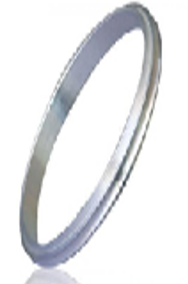
A vacuum connection is an assembly: two mating flanges, a seal or centring ring, and the correct clamping or bolting hardware. Choosing only the nominal diameter does not establish that the joint is suitable for the required pressure, temperature or mechanical load.
Choose the flange system
| System | Construction | Check before assembly |
|---|---|---|
| KF | Quick clamp and an elastomer seal on a centring ring | Matching nominal size, seal material, ring and clamp geometry |
| ISO-K | Large flanges with centring seal and claw clamps | Clamp type, number and arrangement; flange dimensions |
| ISO-F | Bolted flange with centring seal | Bolt pattern, fasteners and tightening sequence |
| CF | Knife edges compressing a metal gasket | Knife-edge condition, exact gasket dimensions and specified fasteners |
KF and ISO assemblies commonly use elastomer seals. CF uses a metal gasket, commonly copper. These constructions have different assembly and temperature requirements. Do not transfer a pressure limit, bake-out temperature or chemical-compatibility statement from one series to another. The weakest component in the assembled line determines the applicable limit.
Size the complete path
Specify the gas, required pressure, temperature, cleanliness and operating cycle. Then check the conductance of the full path: bore, length, bends, valves, reducers and bellows. A pump inlet designation alone does not determine effective pumping speed at the chamber.
Support the pipework so the flanges do not carry unintended weight or bending loads. A bellows accommodates only its specified movements and loads; it is not an unrestricted flexible support. For a turbomolecular pump, use the manufacturer's approved mounting and retention arrangement. An ordinary KF clamp may not provide the required retention.
A practical ordering checklist
- Flange standard and exact nominal size on both ends.
- Part number, drawing and required overall length.
- Body and gasket material; elastomer inner diameter and cross-section where relevant.
- Clamp, claw or bolt kit included in the assembly.
- Temperature, gas compatibility, surface cleanliness and support requirements.
Similar-looking copper CF gaskets are not interchangeable solely by appearance. Match the specified dimensions. Check elastomer seals for cuts, contamination and permanent compression. Replace a knife-edge-marked metal gasket unless the manufacturer's instructions expressly permit reuse.
Assembly and acceptance
Clean and inspect the sealing surfaces. Bring the parts together without forcing misalignment, fit the correct seal, and tighten as specified for that hardware. After assembly, test the complete section, including welds, adapters, valves and instrument ports. Record the configuration, background, test method and response time. A leak test on one component does not establish the tightness of the assembled system.
Select vacuum components · Check dated warehouse stock · Calculate conductance and response