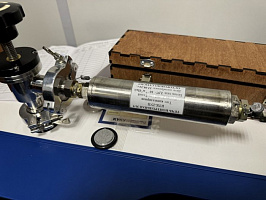
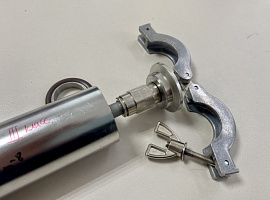
The LeakLab BG calibrated reference leak is a compact source of reproducible gas flow in the 10⁻⁵ to 10⁻³ Pa·m³/s range. It is intended for quick checks, setup and quantitative evaluation of sniffer and vacuum leak detectors. A capillary restrictor in a sealed assembly provides stable flow from a pressure regulator in atmospheric and vacuum test arrangements. The calibration report states the nominal flow, reference conditions and uncertainty.
Description
LeakLab BG Helium Reference Leak with Calibrated Pressure Regulator
LeakLab BG reference leaks reproduce calibrated helium flows for setting up portable sniffer leak detectors, pressure-based leak detectors and leak-testing stations, and for confirming their sensitivity. The assembly uses a calibrated pressure regulator with an integrated reference-leak element to deliver small, stable quantities of gas directly to the test point or process line. The intended measurement approach is consistent with the leak-testing principles described in GOST R 50.05.01-2018 and ISO 20485.
Design
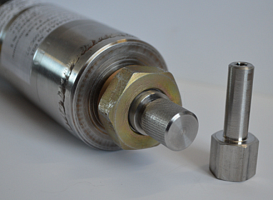
The assembly is based on a calibrated pressure regulator with a high-pressure inlet for a helium cylinder and adjustable outlet pressure. A capillary or porous reference flow restrictor is installed on the low-pressure side. Its stainless-steel body is connected to the regulator by a leak-tight joint. Two pressure gauges show the remaining cylinder pressure and the regulated outlet pressure. Together, these components produce a stable, reproducible helium flow determined by operating pressure, temperature and the transfer characteristic of the reference element.
Flow Principle and Stability
Helium flow through the capillary or porous insert depends on the flow regime inside the channel. At low flow rates and moderate pressure, molecular or transitional flow applies: mass flow is proportional to mean pressure and inversely proportional to the square root of absolute temperature. At higher pressures, laminar flow follows the Poiseuille relationship, with volumetric flow determined by the pressure differential and gas viscosity. Stable regulator outlet pressure and controlled temperature therefore improve flow reproducibility. The reference elements are designed for a low temperature coefficient and minimal drift. The typical expanded uncertainty of the established flow stated in the source description is 10–15% at k = 2, including pressure and temperature effects.
Applications
The BG assembly can be used for functional checks and daily verification of portable leak detectors before a work shift, for calibrating the sensitivity of spray-test stations and for quantitatively evaluating a detected signal as an equivalent helium leak rate. On production lines, the regulator and reference leak can supply small quantities of helium for worst-case search simulations and threshold-setting checks. Compared with ultra-high-vacuum microleaks, it produces larger flows and is suitable for systems operating at atmospheric pressure and for vacuum/sniffer methods.
Range and Typical Characteristics
The series covers helium flows from 1 × 10⁻⁵ to 1 × 10⁻³ Pa·m3/s at 20 °C and at the regulator pressure specified during calibration. The selected flow is recorded in the product passport together with the reference conditions, expanded uncertainty, and pressure and temperature correction factors. Depending on the regulator specification, the inlet is intended for a helium-cylinder pressure of up to 15–20 MPa. Outlet pressure is adjusted smoothly within the range required by the reference element. Helium grade 5.0 or better is recommended to reduce the influence of impurities.
Traceability and Documentation
Each regulator and reference-leak assembly is supplied with a calibration report. The source description specifies calibration by a verified flow standard or by comparison with a working reference leak in a laboratory accredited to ISO/IEC 17025. The report states the nominal flow at reference conditions, uncertainty, temperature coefficient, permissible operating-pressure range and the next calibration date. Under the stated normal operating conditions, the usual calibration interval is 12 months.
Use with Portable Leak Detectors
Before checking a leak detector, purge the instrument as required and allow its zero reading to stabilize. Install the regulator on the cylinder, set the outlet pressure to minimum and increase it gradually until the indicated signal corresponds to the sensitivity threshold required for the test. Place the detector probe at the reference-leak outlet and record the response and signal reproducibility. After sensitivity has been confirmed, retain the approved instrument settings and begin leak testing of the product. Move the probe into clean air to check for false indications and confirm correct zero adjustment.
Use with Pressure-Based Methods
When a pressure-based leak detector is checked, connect the BG reference leak to the test volume through an adapter to create a known equivalent gas inflow. The measured rate of pressure change is used to determine system sensitivity and compare it with the specified leak-tightness class. This method can be used when qualifying chamber-type or vacuum/pressure leak-testing stations.
Process Integration
In production equipment, the regulator and reference leak can provide stable small quantities of helium for tracer-flow marking, in-process checks of heat exchangers and shut-off valves, and periodic self-checks of measurement channels without dismantling the equipment. The reference-leak outlet may be routed into an equipment cabinet, with flow adjusted using the regulator control.
Operating Recommendations
For stable readings, operate the assembly at a stable room temperature, away from drafts and local helium sources. A short helium purge through the reference element before each shift helps remove air. Fit the protective cap to the outlet during storage, unload the regulator and close the cylinder valve. Secure the gas cylinder, check the pressure gauges regularly, and keep oil and moisture out of the gas path. Only trained personnel should operate the regulator, in accordance with applicable compressed-gas-cylinder safety instructions.
Engineering Notes
The nominal flow of each individual reference leak is stated at reference conditions of 20 °C and 101.325 kPa. Use the coefficient in the passport when converting the value to another temperature. For preliminary estimates in the molecular-flow region, mass flow depends on mean pressure and is inversely proportional to the square root of absolute temperature. In the laminar region, the isothermal Poiseuille model applies and is sensitive to helium viscosity. Because calibration determines the transition between regimes, use the passport values and supplied correction factors for metrological work.
Scope of Supply and Service
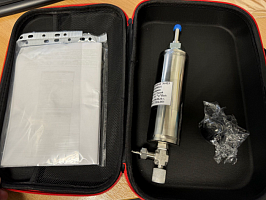
The stated scope of supply comprises the pressure-regulator/reference-leak assembly, product passport, calibration report, outlet protective cap, operating manual and guidance for checking leak-detector sensitivity. Other nominal-flow elements, flexible sampling lines, probe-tip adapters and connections for pressure-based stations are available on request. Verification, recalibration, regulator repair and restoration of the reference element can be provided with confirmation of its characteristics.
Summary
The LeakLab BG assembly combines a calibrated reference leak with a pressure regulator to generate reproducible small helium flows for daily leak-detector checks and quantitative calibration of test stations. It covers the 10−5 to 10−3 Pa·m3/s range for atmospheric-pressure and vacuum/sniffer arrangements.
Specifications
| Product Label | Recommended |