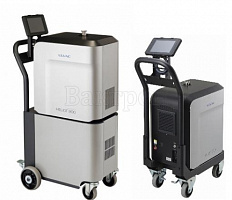
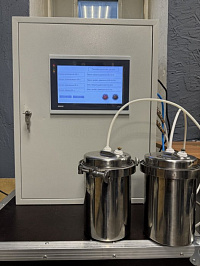
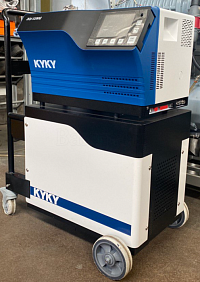
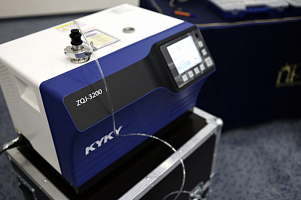
Pressure-rise instrument for testing evacuated vessels and vacuum systems over time. It records pressure, applies the entered test volume and calculates total gas load; the method does not by itself distinguish real leaks from outgassing or trapped volumes.
Description
LeakLab VacuumTest Vacuum-Decay Leak-Test Instrument
VacuumTest monitors an evacuated and isolated object and calculates gas load from the pressure increase over a defined interval. It is intended for vacuum-retention tests, pump-down diagnostics, drying and process checks.
| Pressure principle | MEMS Pirani thermal-conductivity sensor with atmospheric reference in the source configuration |
|---|---|
| Nominal air or nitrogen range | 100,000–1 Pa |
| Response time stated in source configuration | ≤300 ms |
| Display units | Pa, Torr and mbar |
| Outputs | Logarithmic analog output and RS-485 Modbus RTU |
| Process connection | KF16 |
| Supply / power | 9–24 V DC nominal / ≤1.2 W |
For a constant volume and approximately uniform temperature, total gas load is estimated from Q = V·Δp/Δt. The result includes leakage, outgassing, permeation, valve conductance and temperature effects. Separating these mechanisms requires a validated procedure and often additional tests.
Pirani indication is gas-dependent. Enter the actual isolated volume, stabilize temperature, document valve timing and verify the pressure channel over the test range before applying a pass/fail limit.
Specifications
| Product Label | Promotion |